

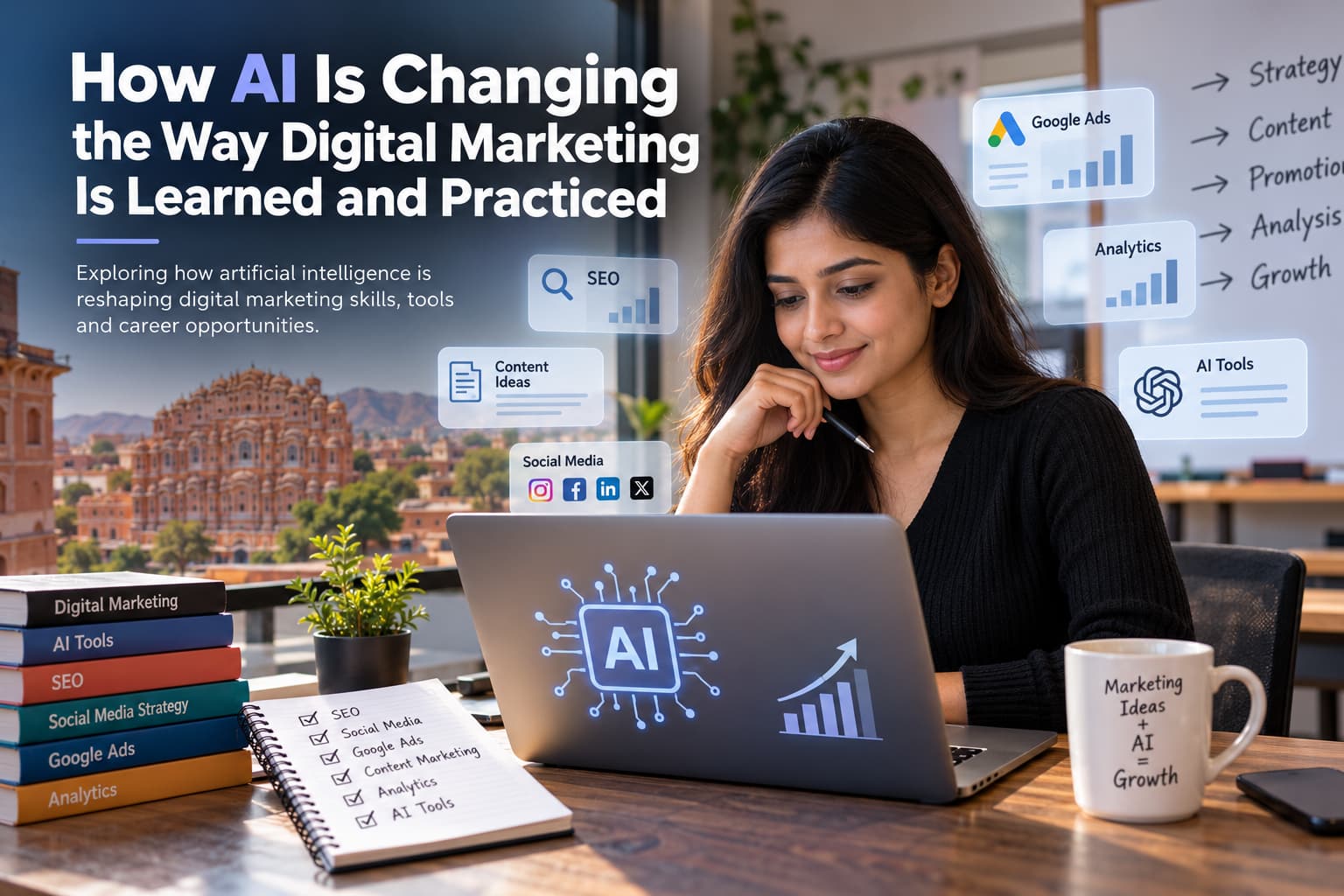
Digital marketing has changed significantly over the last few years. Earlier, marketers mainly focused on search engine optimization, social media posting, paid advertising, email campaigns, and basic analytics. Today, artificial intelligence has become part of almost every major marketing activity.
From generating content ideas to analysing customer behaviour, creating ad variations, automating repetitive work, and improving campaign decisions, AI is changing how marketers work. As a result, students and professionals entering the digital marketing industry need to understand both traditional marketing fundamentals and modern AI-powered workflows.
Digital Marketing Is Becoming More AI-Driven
Artificial intelligence is no longer limited to large technology companies. Digital marketers, agencies, freelancers, startups, and businesses are increasingly using AI tools in their everyday work.
For example, AI can help marketers research keywords, analyse competitors, create content outlines, generate advertising concepts, summarise campaign data, personalise communication, and identify patterns in customer behaviour.
However, using AI effectively requires more than simply entering prompts into a tool. A marketer still needs to understand the audience, business objectives, customer journey, branding, conversion strategy, and performance metrics.
This is why modern digital marketing education needs to combine marketing fundamentals with practical exposure to AI tools.
Why Practical Digital Marketing Skills Matter
Digital marketing is a skill-based field. Understanding definitions and theories is useful, but practical execution is what ultimately develops confidence.
A learner may understand what Google Ads, SEO, Meta Ads, or analytics mean, but working on an actual campaign involves many additional decisions.
For example, while running a paid advertising campaign, marketers may need to:
- identify the correct target audience;
- choose a suitable campaign objective;
- prepare ad copy and creatives;
- decide the campaign budget;
- configure tracking;
- analyse performance;
- identify underperforming elements; and
- optimise the campaign based on real data.
The same principle applies to SEO, social media marketing, content marketing, email marketing, and other digital channels.
Therefore, students exploring an AI-Digital Marketing Course in Jaipur should ideally look for a learning approach that includes practical assignments, projects, marketing tools, campaign understanding, and exposure to AI-assisted workflows.
Important Skills Modern Digital Marketers Should Learn
The responsibilities of digital marketers continue to expand. While job requirements vary depending on the organisation and role, several skills are becoming increasingly valuable.
Search Engine Optimization
SEO remains an important part of organic digital growth. Learners should understand keyword research, search intent, on-page optimization, technical SEO basics, internal linking, content planning, backlinks, and performance measurement.
With AI-powered search experiences becoming more common, marketers are also beginning to pay greater attention to how content is structured for search engines, answer engines, and AI-powered discovery platforms.
Social Media Marketing
Social platforms allow businesses to build communities, communicate with customers, and promote their products or services.
A digital marketer should understand content planning, platform-specific strategies, audience engagement, short-form video content, creative testing, performance analysis, and paid social campaigns.
AI can assist with content ideas and production, but marketers still need human judgement to understand tone, brand positioning, and audience preferences.
Google Ads and Performance Marketing
Paid advertising requires strong analytical and decision-making skills.
Learners should understand campaign objectives, keywords, bidding, targeting, landing pages, conversion tracking, cost-per-click, cost-per-lead, return on advertising spend, and campaign optimization.
AI-powered advertising systems are making automation more common, but understanding campaign fundamentals remains essential for evaluating whether automated recommendations actually support business goals.
Content Marketing
Content remains a major part of online marketing.
Businesses publish blogs, landing pages, social media posts, videos, emails, case studies, and other forms of content to educate and attract potential customers.
AI can accelerate research and drafting, but quality content still requires fact-checking, editing, originality, audience understanding, and strategic planning.
Analytics and Data Interpretation
Modern marketers work with large amounts of data.
Understanding metrics such as website traffic, click-through rate, engagement rate, conversion rate, acquisition cost, bounce rate, and campaign revenue helps marketers make better decisions.
The objective is not simply to collect data but to understand what the numbers indicate and determine the next action.
How AI Can Support Digital Marketing Work
AI tools can improve productivity across several marketing tasks.
For example, marketers can use AI for brainstorming campaign ideas, preparing first drafts, researching customer questions, creating ad-copy variations, analysing datasets, building automation workflows, and summarising reports.
AI can also help professionals complete routine work faster, allowing more time for strategic activities such as campaign planning, creative direction, customer research, and optimization.
At the same time, AI-generated outputs should always be reviewed. Incorrect information, weak brand alignment, repetitive content, or inaccurate recommendations can reduce campaign quality.
Successful marketers will therefore need to learn how to work with AI rather than depending completely on it.
Projects Help Learners Build Real Confidence
One of the most useful ways to learn digital marketing is by completing projects.
A student could create a basic website, perform keyword research, prepare an SEO plan, develop social media content, create sample advertisements, analyse competitors, set up analytics, or build a marketing campaign for a hypothetical or real business.
Projects help connect individual skills together.
Instead of learning SEO, advertising, content, and analytics as completely separate topics, students begin to understand how different marketing channels contribute to a common business objective.
Practical projects can also become part of a learner’s portfolio, which may help demonstrate skills when applying for internships, jobs, freelance assignments, or client work.
Digital Marketing Offers Multiple Career Paths
Learning digital marketing does not lead to only one type of role.
Depending on their interests and skills, learners can explore opportunities in areas such as:
- SEO;
- social media marketing;
- performance marketing;
- Google Ads;
- content marketing;
- marketing analytics;
- e-commerce marketing;
- email marketing;
- marketing automation;
- digital strategy; and
- AI-assisted marketing.
Some professionals eventually specialise in a single field, while others develop broader skills and work as digital marketing executives, consultants, freelancers, or agency professionals.
Entrepreneurs and small-business owners can also benefit from digital marketing knowledge because it helps them understand how online customer acquisition works.
Choosing the Right Learning Approach
Before selecting a digital marketing program, learners should evaluate how the training is delivered.
A useful course should not focus only on completing modules. Students should understand how concepts are applied in real situations.
Important factors to consider include practical assignments, trainer experience, live demonstrations, project work, exposure to commonly used tools, campaign analysis, analytics, and opportunities to ask questions.
Since the digital marketing industry changes quickly, learners should also develop the habit of continuously experimenting and updating their skills.
Final Thoughts
Artificial intelligence is changing digital marketing, but it is not replacing the need for marketing knowledge.
In fact, AI makes strong fundamentals even more important. Marketers need to understand strategy, customers, platforms, data, creativity, and business objectives before they can use automation effectively.
For students and professionals preparing for careers in digital marketing, the most valuable learning approach combines theoretical understanding with practical execution.
Those who can understand marketing fundamentals, work confidently with digital platforms, interpret data, and use AI responsibly will be better prepared for the increasingly technology-driven marketing industry.