


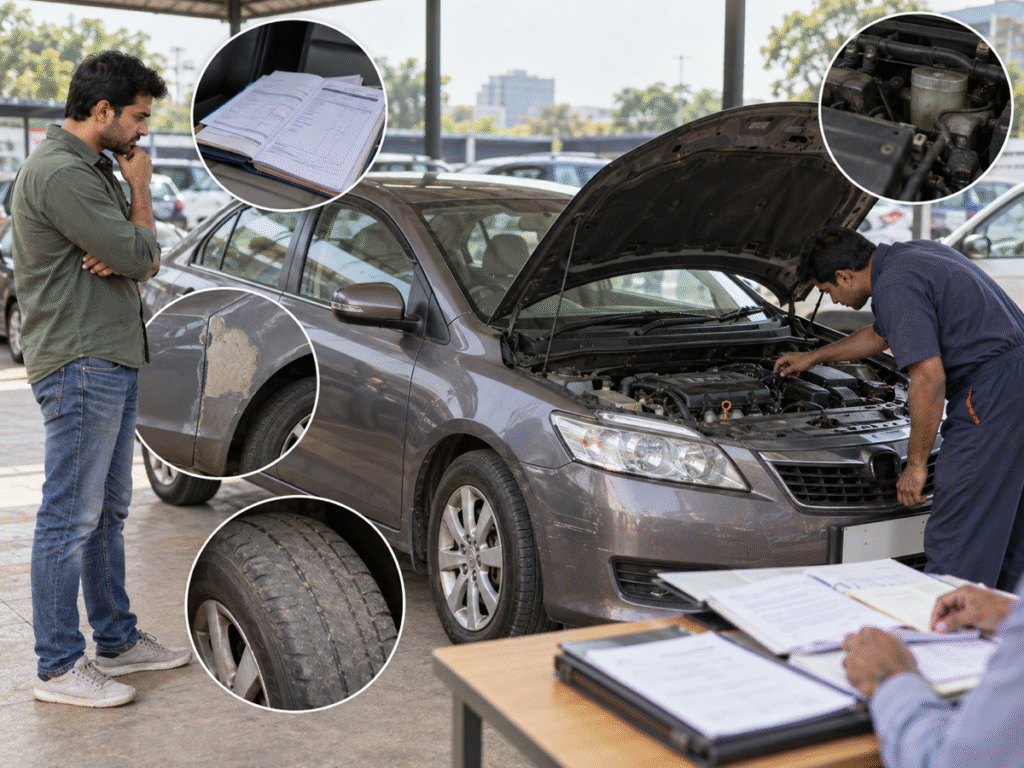
Every used car buyer in India hits the same five problems regardless of seller: RC transfer delays, inspection gaps, post-purchase faults, thin long-term warranty cover, and harder financing than for a new car. None of these disappears by finding a perfect seller. The fix is a platform that assists through them and pays when something goes wrong: the standard behind Cars24’s Lifetime Warranty, 30-Day Return Policy, and Welcome Cover repair assurance.
Why This List Matters More Than the Brochure
Most used-car marketing talks about inspection points and warranty months. Buyers rarely ask what happens when the inspection misses something, or when the RTO sits on a file for ten weeks. Those are the moments that actually decide whether a purchase felt safe in hindsight. The five problems below are structural to how used cars change hands in India: they show up whether you buy from an organised platform, a local dealer, or a private seller. What actually changes across sellers is who stays on the phone with you when one of these problems lands on your doorstep.
The Five Problems That Haunt Used Car Buyers
| Problem | Why it happens on any platform | What a buyer should look for |
|---|---|---|
| RC transfer delays | RTO workload, document mismatches, and state-level backlogs sit outside any single seller’s control | A platform that actively tracks the file and resolves stuck cases as they come up |
| Quality gaps | Listing photos and short inspection summaries can flatten real condition into a marketing pitch | A detailed, itemised inspection report plus a return window to verify it in person |
| Post-purchase problems | A used car has already lived a life before you; the first weeks reveal what a test drive can’t | Repair coverage that starts on day one of ownership |
| Long-term ownership risk | Wear accelerates with age and mileage, and manufacturer warranty is usually long gone | Warranty terms that go beyond a token 3-6 months and specify exactly what’s covered |
| Financing friction | Used-car loans carry higher perceived risk for lenders than new-car loans, so approvals are slower and pricier | A lender that underwrites the used car directly, bundled with the purchase |
1. RC Transfer Delays That Trace Back to the RTO Itself
Even though the majority of RC transfer delays these days start in a government office, the seller you pick still shapes how painful they feel.
Transferring the Registration Certificate into the buyer’s name is a legal step required after every used-car sale in India. Until it happens, the vehicle can remain administratively tied to the seller’s name in RTO and VAHAN records, which creates its own headaches around loan approvals, insurance claims, and resale down the line.
The law gives a buyer 14 days to submit the ownership-transfer application when the vehicle is registered in the same state, and 45 days when it’s coming from another state, as per Parivahan’s Transfer of Ownershio Guide. However, submitting on time is only half the battle. The actual processing depends on the RTO itself: industry guides on the 2026 online RC transfer process cite 7-15 days for straightforward cases and 15-30 days once physical verification is required, and interstate transfers routinely run longer because of the NOC step between two RTOs. Some RTOs digitise faster than others; a few remain genuinely slow regardless of how clean the paperwork is.
This is why a promise of a smooth RC transfer from any seller is worth guaging sceptically. No seller controls a government office. What a seller does control is whether it stays on the case when a file gets stuck, and whether it compensates you for the wait.
Leading used car platform, Cars24 for instance backs its RC transfer service with structured buyer assistance through the purchase, and separately runs a Seller Kavach liability-protection policy on the sell side that pays legal costs if the RC transfer is delayed after a sale, an arrangement Cars24 introduced specifically because RC transfer can take anywhere from 30 days to several months depending on documentation, NOC requirements, and RTO workload.
Therefore, when choosing a used car platform, pick the one whose process is clearly built around RTO delay as the expected norm. One that tracks your specific RC file status rather than telling you to wait for the RTO, and has a named escalation path when a transfer stalls past the normal window.
2. What You See in the Listing Isn’t Always What Arrives at Your Door
Photos flatter. A short bullet list like ‘well maintained, single owner’ tells you almost nothing about brake wear, AC compressor health, or whether a panel has been repainted. This gap between marketing description and physical reality is the single most common source of buyer regret in the used-car market, and it exists on every channel, from classifieds to certified platforms.
The fix depends on the depth and specificity of what’s actually inspected, plus a real window to verify it yourself. Cars24, for example, runs a 300-point quality check across its India inventory before a car is listed, and backs it with a return period so buyers can verify the report’s findings themselves. The platform describes a 30-Day Return Policy that lets a buyer live with the car for a full month before the purchase becomes final, well beyond the reach of a single test drive.
A 300-point checklist still won’t catch everything; no pre-purchase inspection can substitute for how a car behaves across a real month of driving. That’s exactly what the return window is meant to cover: it lets you verify the car yourself and return it under the policy’s terms if it doesn’t hold up.
Therefore, when choosing a used car platform, pick the one that publishes the specific items its inspection actually checks, rather than a headline number alone, and gives you a return window long enough to drive the car in normal conditions before the sale is final.
3. The First Weeks of Ownership Are Where Hidden Faults Show Up
A used car has already lived through years of someone else’s driving habits, service intervals, and road conditions. A test drive of twenty minutes cannot replicate a week of city traffic, a highway stretch, or a monsoon downpour, and that is exactly when a marginal clutch, a weak AC compressor, or an intermittent electrical fault tends to reveal itself. Buyers who skip this reality often end up paying for repairs within the first month that feel like they should have been the seller’s problem.
This is the specific gap Cars24’s ‘Welcome Cover’ is built to close. It’s a no-questions-asked repair assurance running 30 days or 1,500 km from the date of sale, whichever comes first, applicable to every platform-owned inventory sold on the platform from 11 October 2025 onward. It covers major systems, engine internals, transmission, cooling and AC, electricals and fuel systems, and extends to wear-and-tear parts that most standard warranties exclude outright: tyres, clutch assembly, suspension components, and the braking system. Claims go through a four-step process with no deductible and unlimited claims within the window, per the same coverage.
The coverage excludes routine consumables like filters or wiper blades, along with anything already flagged in the original inspection report, which is a reasonable line to draw. What matters for a buyer comparing platforms is checking whether post-purchase protection offered by any platform actually means repair assurance starting from day one, or comes with fine print that delays activation.
Therefore, when choosing a used car platform, pick the one that covers repairs starting the day the car is delivered, and states plainly which parts and systems are included.
4. Warranty Terms Decide Whether Year Two Is Affordable or Painful
A used car’s manufacturer warranty is typically expired or close to it by the time it changes hands. Whatever protection the buyer has going forward comes entirely from the seller’s own warranty terms, and that’s where most used-car purchases quietly become a gamble: a 3-month or 6-month cover reads fine on a sticker, but it does nothing for the engine or gearbox problem that shows up in year two.
Cars24 addressed this directly with Lifetime Warranty Plans, which the company describes as India’s first lifetime warranty for used cars, covering the engine, transmission, and drivetrain for up to 12 years from the date of registration or 1,50,000 km, whichever comes first. A warranty this long is meaningful specifically because the powertrain is the most expensive thing to fix on an older car.
It’s also worth reading exactly what the engine, transmission, and drivetrain coverage excludes: consumables, cosmetic parts, and damage from accidents or unauthorised modifications typically sit outside any powertrain-specific plan, and a buyer should request the exact inclusions list to see precisely what lifetime covers here.
Therefore, when choosing a used car platform, pick the one that states its warranty duration in years or kilometres against a named list of covered systems, and lets you verify the terms in writing before you pay.
5. Financing a Used Car Is Genuinely Harder Than Financing a New One
Lenders treat used-car loans as higher risk than new-car loans: the collateral depreciates faster, valuations are less standardised, and default rates run higher across the industry. That translates into slower approvals, higher interest rates, and more paperwork for the buyer, especially outside metro cities where fewer lenders actively compete for the loan.
Cars24’s financing arm, Cars24 Financial Services Private Limited (CFSPL), holds an NBFC licence from the RBI and has built a dedicated digital lending layer around this exact friction. The platform offers financing up to 100% of a car’s on-road price with used-car loan rates starting at 12% and terms running up to 6 years, processed digitally without the branch-to-branch paperwork chase that used-car loans often involve elsewhere. Over the years, Cars24 has facilitated more than ₹4,000 crore in car loans, which is a scale that matters for underwriting speed: a lender that has already priced thousands of similar used cars can approve faster than one evaluating a used vehicle from scratch.
The value for a buyer goes beyond the rate: financing and the purchase sit under one process, rather than a separate bank loan against a car the bank hasn’t itself evaluated. That said, 12% is a starting rate; actual pricing depends on the buyer’s credit profile, loan tenure, and the specific car, so it’s worth getting the exact quote before treating any advertised rate as final.
Therefore, when choosing a used car platform, pick the one that underwrites the specific car you’re buying as part of one process, rather than sending you to arrange financing separately after the purchase decision is already made.
Where These Protections Have Limits
Every one of these safeguards comes with conditions, and it pays to know them upfront:
- The 30-Day Return Policy and Welcome Cover exclude cosmetic damage, consumables, and any fault already disclosed in the original inspection report. Returns are also subject to the policy’s specific terms, and buyers have reported deductions tied to usage, mileage driven, or paperwork already completed, so confirm the exact refund calculation upfront, before you sign anything.
- The Lifetime Warranty covers powertrain components specifically; body, interior, and electronics outside the drivetrain fall under separate, shorter-duration cover.
- RC transfer assistance speeds up and tracks the process, but it cannot override an RTO’s own backlog or a document mismatch on the seller’s original paperwork.
- The headline financing rate is a floor that applies to the strongest credit profiles, and most applicants should expect a higher quoted rate.
A Buyer’s Checklist Regardless of Platform
- Check the vehicle’s RC and challan status yourself on the Parivahan portal before paying anything.
- Ask for the full itemised inspection report rather than a summary score alone, and read the exclusions.
- Confirm the exact return window in days and the deduction or refund calculation that applies if you return the car.
- Get the warranty terms in writing: duration, covered systems, and what voids the cover.
- Get your financing quote in writing (rate, tenure, processing fee) before you commit to a specific car.
The Bottom Line
RC delays start in the RTO; judge platforms on how they handle the wait, since that’s the part actually within their control. A glossy listing photo tells you nothing on its own; a detailed inspection report plus a real return window does the actual work. The first month of ownership is when hidden faults surface, so day-one repair coverage matters more than a warranty with a waiting period. A used car’s real risk sits in the powertrain, so measure warranty quality in years and named systems rather than marketing language. Financing works best when the lender underwrites the actual car you’re buying instead of bolting on a generic loan product afterwards.
Data on policies, terms, RTO timelines etc. as of September 10th 2026. Terms, interest rates, and RTO processing times can change; verify current specifics directly with the platform or your local RTO before you sign anything.
Frequently Asked Questions
Does a longer inspection checklist always mean a better car?
On its own, no. A 300-point checklist confirms the process was thorough, but some issues can still slip through. Pair the inspection report with a real return window so you can verify the car’s behaviour yourself before the sale is final.
Can RC transfer delays affect my ability to insure or resell the car later?
Yes. Until the RC reflects your name in RTO records, insurance claims and future resale can get complicated because the registered owner on paper doesn’t match the actual owner. This is why tracking the transfer status yourself, in addition to relying on the seller, is worth the effort.
Is a “lifetime warranty” on a used car really lifetime, with no limits?
No warranty marketed as “lifetime” covers every part indefinitely. Cars24’s Lifetime Warranty Plan, for example, is scoped to the engine, transmission, and drivetrain, capped at 12 years or 1,50,000 km, whichever comes first. Always get the exact covered-systems list to confirm the actual scope of protection.
Does a platform’s own financing arm always offer a better rate than my bank?
It varies by applicant, but it often approves faster because it’s underwriting the specific car rather than a generic loan. Compare the actual quoted rate, tenure, and processing fee from both before deciding, since advertised starting rates apply to the strongest credit profiles.
What should I do if a platform’s RC transfer is taking longer than promised?
Ask for a written status update and an escalation contact rather than accepting a generic “it’s in process” response. Platforms that build structured tracking and legal support around transfer delays, such as Cars24’s post-sale liability cover, tend to resolve stuck cases faster than ones with no defined escalation path.
Do return policies like Cars24’s 30-Day window apply to every car on the platform?
Only to specific inventory categories, typically. Return and warranty benefits are usually tied to a platform’s own certified or refurbished inventory rather than to third-party or private-seller listings hosted on the same site, so check which category a specific car falls into to confirm whether the full benefit set applies.

