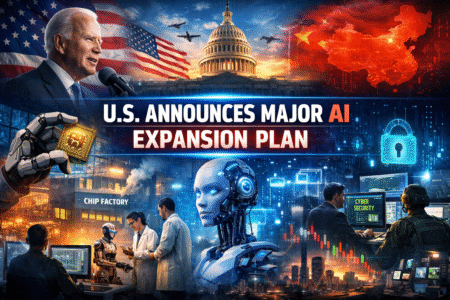

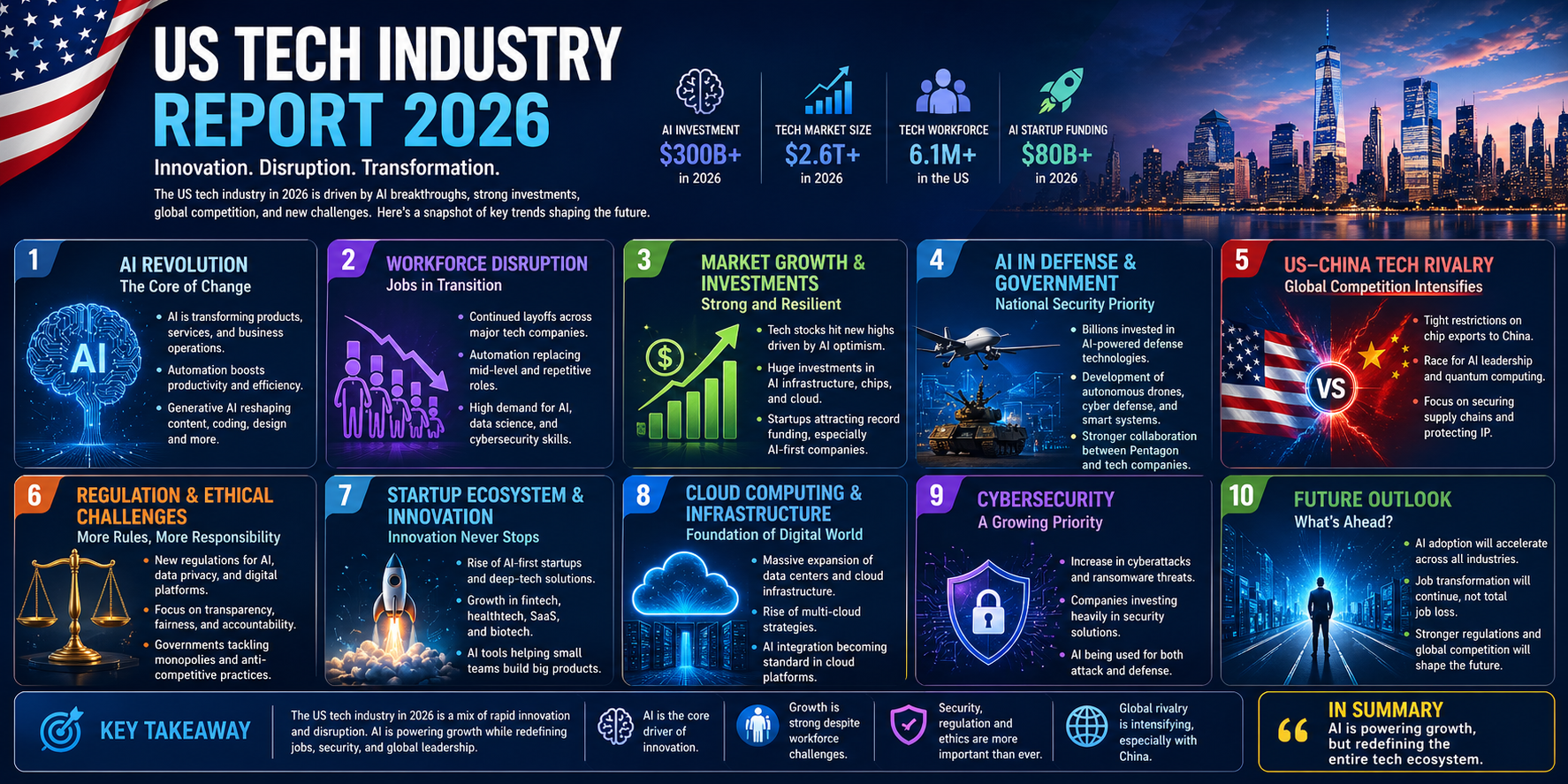
The United States technology sector in 2026 stands at a critical turning point. Driven by rapid advancements in artificial intelligence (AI), evolving global competition, regulatory pressure, and shifting economic conditions, the industry is experiencing both unprecedented growth and significant disruption. This report provides a structured yet concise overview of the key developments shaping the US tech landscape today.
🤖 1. The AI Revolution: Core Driver of Change
Artificial Intelligence has become the backbone of the modern tech ecosystem. Leading companies such as Microsoft, Google, and Meta are aggressively expanding their AI capabilities.
AI is no longer limited to experimental projects—it is now embedded into everyday products and services. From chatbots and virtual assistants to enterprise-level automation systems, AI is transforming how businesses operate. Companies are using AI to:
- Automate repetitive tasks
- Enhance customer experience
- Improve decision-making using predictive analytics
- Optimize supply chains and logistics
Additionally, generative AI tools are reshaping industries such as content creation, coding, and design. Businesses are rapidly integrating AI APIs into their workflows, reducing operational costs and increasing efficiency.
However, this shift is also raising concerns about over-dependence on AI systems and the ethical implications of machine-driven decisions.
📉 2. Workforce Disruption and Layoffs
While AI is driving innovation, it is also reshaping the job market. In 2026, the US tech industry has witnessed continued layoffs across major firms. Companies are restructuring to become more efficient and AI-focused.
Key trends include:
- Replacement of mid-level roles with automation
- Reduced hiring in traditional software roles
- Increased demand for AI specialists, data scientists, and cybersecurity experts
The shift toward leaner organizations means fewer employees are required to achieve the same or higher output. This has created a paradox: while the tech industry is growing financially, employment opportunities in certain areas are shrinking.
Reskilling has become essential. Professionals are now expected to adapt quickly by learning AI tools, machine learning concepts, and advanced technical skills.
💰 3. Market Growth and Investment Trends
Despite layoffs, the financial performance of the tech sector remains strong. Companies like Apple, Amazon, and NVIDIA continue to dominate the market.
Major investment areas include:
- AI infrastructure (data centers, GPUs)
- Semiconductor manufacturing
- Cloud computing platforms
- Quantum computing research
NVIDIA, in particular, has seen explosive demand due to its dominance in AI chip production. Meanwhile, cloud providers are expanding their services to support AI workloads.
Venture capital is also shifting focus. Investors are prioritizing “AI-first” startups—companies that build their entire business model around artificial intelligence. This has led to record-breaking funding rounds in sectors like healthtech, fintech, and autonomous systems.
🛡️ 4. Government Spending and AI in Defense
The US government is significantly increasing its investment in advanced technologies, particularly AI. Defense agencies are developing:
- Autonomous drones
- AI-powered surveillance systems
- Cybersecurity infrastructure
- Advanced battlefield analytics
Collaboration between government bodies and private tech companies is stronger than ever. Firms like Palantir Technologies are playing a crucial role in defense-related AI projects.
This trend highlights the strategic importance of AI not just for economic growth, but also for national security.
🌍 5. Global Competition: US vs China
The technology rivalry between the United States and China is intensifying in 2026. Both nations are competing for dominance in AI, semiconductors, and quantum computing.
Key developments include:
- US restrictions on advanced chip exports to China
- Increased domestic production of semiconductors
- Efforts to secure supply chains
- Cybersecurity concerns and intellectual property protection
This competition is not just economic—it is geopolitical. Control over advanced technologies is seen as a key factor in global power.
⚖️ 6. Regulation and Ethical Challenges
As technology advances, regulatory scrutiny is increasing. Governments are introducing new rules to address:
- Data privacy concerns
- AI bias and transparency
- Misinformation and deepfakes
- Market monopolies
Big tech companies are under pressure to ensure ethical use of AI. There is growing demand for transparency in how algorithms make decisions.
Regulatory bodies are also focusing on preventing anti-competitive behavior, especially among dominant firms.
🚀 7. Startup Ecosystem and Innovation
Innovation remains a strong pillar of the US tech industry. Startups are driving breakthroughs in emerging fields such as:
- Artificial Intelligence
- Biotechnology
- Financial technology (fintech)
- Software-as-a-Service (SaaS)
The startup ecosystem is becoming more specialized, with founders focusing on niche problems and deep-tech solutions. AI tools have lowered the barrier to entry, allowing smaller teams to build powerful products.
However, competition is intense, and only startups with strong differentiation and scalability are attracting significant funding.
🌐 8. Cloud Computing and Infrastructure Expansion
Cloud computing continues to grow rapidly, supporting the increasing demand for AI and data processing. Companies like Amazon Web Services and Microsoft Azure are expanding their global infrastructure.
Trends include:
- Rise of multi-cloud strategies
- Increased focus on data security
- Integration of AI tools into cloud platforms
Cloud providers are becoming the backbone of digital transformation across industries.
🔐 9. Cybersecurity: A Growing Priority
With increased digitalization comes greater risk. Cybersecurity is now a top priority for both companies and governments.
Key concerns:
- Ransomware attacks
- Data breaches
- AI-driven cyber threats
Organizations are investing heavily in security solutions to protect sensitive data and maintain trust.
🔮 10. Future Outlook
Looking ahead, the US tech industry is expected to continue evolving rapidly. Key predictions include:
- AI becoming a standard tool across all industries
- Further job transformation rather than complete job loss
- Stronger regulations shaping tech development
- Continued global competition, especially with China
The industry’s future will depend on how effectively it balances innovation with responsibility.
📌 Conclusion
In 2026, the US tech sector is defined by a powerful mix of growth and disruption. Artificial intelligence is driving progress across industries, but it is also reshaping jobs, increasing competition, and raising ethical concerns.
In summary:
- AI is the central force behind innovation
- Economic growth remains strong despite layoffs
- Global competition is intensifying
- Regulation and ethics are becoming critical
The US tech industry is not just evolving—it is being completely redefined.